Sub-Saharan Africa Digital Infrastructure Outlook for 2023

Digital transformation is crucial for Africa, particularly its potential impact on sectors such as health care, education, and government. To measure the status of, and readiness for, digital transformation, one must consider the prerequisites for its realization starting with digital infrastructure and connectivity services. The COVID-19 pandemic has highlighted the importance of adequate digital infrastructure and services.

Unfortunately, many are still without access to vital infrastructure due to coverage or affordability gaps. As we have seen during the pandemic, those without connectivity are excluded from the digital economy and its benefits such as tele-health and remote learning and work. Digital infrastructure expansion and investment can help to increase internet usage and drive the digital economy.

Both globally and across Africa, internet usage and demand for services continue to rise despite economic downturns. Telecommunication services providers are facing pressure to expand, maintain, and upgrade vital infrastructure required to support vital connectivity services.  The goal of greater digital transformation, and thus, infrastructure investment, will continue to shape the digital infrastructure landscape throughout 2023 and into the future.

Supply-Side Themes: Digital Infrastructure Investment Trends

Recent trends in Sub-Saharan Africa infrastructure investments include the materialization of next-generation subsea cables, as older cables approaching 20 years reach their end of life.  Over the last several years, we are seeing that these submarine cables are increasingly funded by OTT players rather than traditional telcos.

 Investment in long-haul terrestrial fiber networks continues, but as traditionally viable areas become increasingly connected, it can become more costly to connect small and medium sized cities. Many operators, especially in more developed markets, are more focused on densification of metro and access networks. This is vital to support 4G expansion, prepare for 5G, facilitate rollout of access fiber to drive Fiber-to-the-Home and Business plays.

This trend can be observed in Figure 2 which illustrates how Fiber Reach (% population within 5 km of a fiber cable) has evolved in select African markets since 2019.
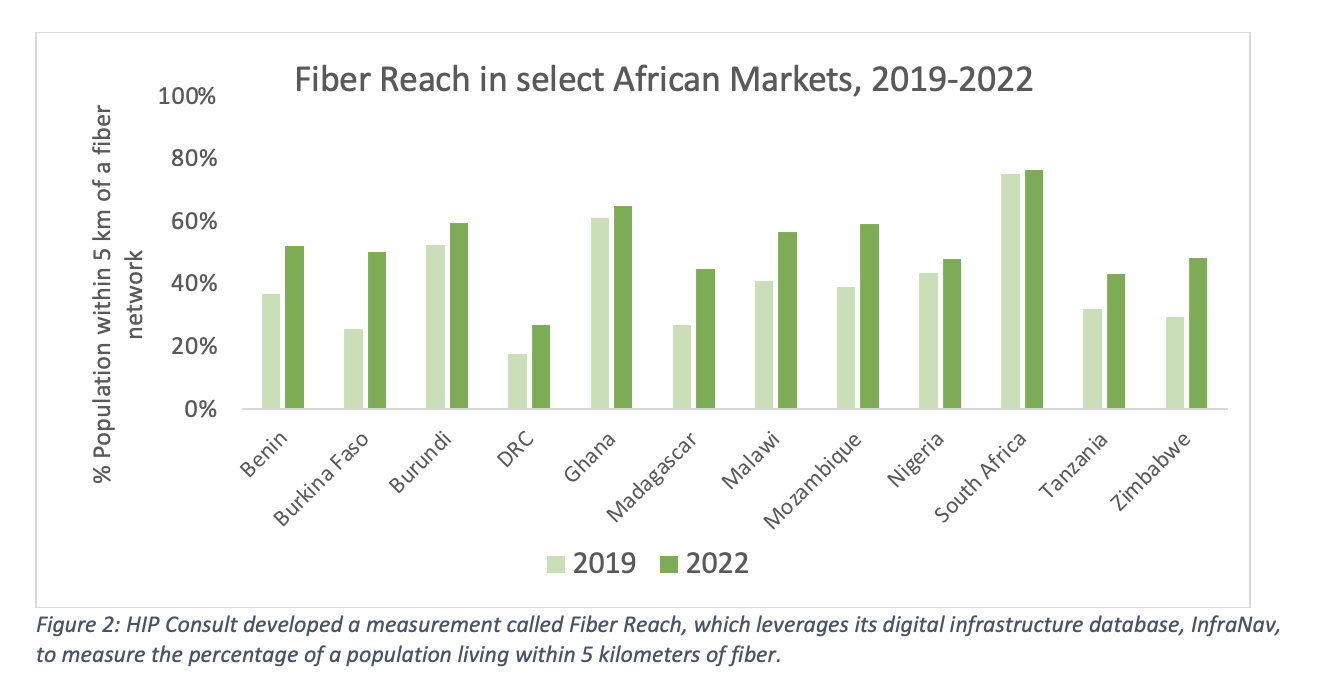
Plateaus in certain markets do not necessarily represent slowed network coverage, but rather an increased redundancy and densification in urban centers, with more players competing for similar customers.  In certain cities, FTTx is reaching a stage of maturity where battle lines are drawn in contended cities, and internet service providers (ISPs) are starting to consolidate.

While 5G is yet to live up to its global hype, and really just getting started in Africa, the technology’s dense infrastructure requirements are driving further driving urban infrastructure densification. Commercial 5G pilots will continue to emerge, though 5G coverage and adoption may not be realized for quite some time, especially beyond the use cases such as FWA. We also expect to see the towerco industry evolve, as many MNOs sell off their assets, resulting in more funds for network expansion and cost reduction through shared Opex.

Lastly, international and local data center capacity will continue to grow quickly as longstanding capacity gaps begin to close with some high-scale investments, with “hyperscalers” begin to make a presence. While adoption of cloud services is a near-term driver, meaningful advancements in artificial intelligence and machine learning may further drive demand for cloud services in the medium to longer term.

As digital infrastructure expansion and investment becomes more nuanced, firms will require more granular insights, as well as predictive analytics, to adequately uncover potential opportunities and invest in an optimal fashion.


Questions or comments?  Interested in discussing further?  Contact us to arrange for a meeting with a member of the HIP Consult team.


Electrifying a Greener ICT Industry: Data Centers

This is the first of a series of HIP Consult blogs on the climate crisis and the ICT industry. As climate change moves into the foreground of international politics and increasingly influences corporate decision-making, players within the ICT industry have begun to grapple with potential ways to “greenify” an industry that is reliant on electricity to keep populations connected and integrated with the digital economy.

The largest culprit in the ICT industry are data centers – carrier hotels, cloud farms, etc. – which house the world’s digitally stored data.  As of 2018, the ICT ecosystem contributed over 2% of overall global carbon emissions, while data centers alone contributed around .3%. As the digital economy grows, these contributions will only continue to skyrocket, with some projections associating 8% of projected global electricity demand by 2030 with the energy demand of data centers.

Data centers require electric power to consistently run computers servers and cooling systems to avoid overheating. Traditionally, data centers have been connected to the local electrical grid which may not be run off clean or renewable sources.

The current electricity situation for the data center industry is not sustainable, and it is beginning to crack. The high electricity demand of data centers can overload legacy transmission networks, overtaking supply during peak times and causing load shedding or rolling blackouts. This has been well-reported in Ireland recently, as EirGrid’s forecast that data centers could account for 25% of all electricity demand in Ireland by 2030 influenced a new policy that will have data centers provide their own power at times of high demand. However, this move has been met with trepidation from climate change activists, as on-site facilities would likely utilize petroleum or diesel sources which can be easily turned on and off as needed.

In some parts of the globe, data center providers have leveraged the natural cooling power of their surrounding climate to reduce their electricity demand. There has been a trend for new builds to occur in cooler climates, such as in Sweden and Norway, where outside air can be blown in to prevent overheating. (These Scandinavian markets have the added benefit of sourcing much of their national electricity supply from non-fossil fuel sources, including hydro and nuclear power.) Since it is not possible to reduce the overall electricity demand of data centers this way in all markets, remaining demand must be met by renewable energy wherever possible.  

In emerging markets, there has been a surge in plans to build climate friendly data centers, mostly by leveraging ample sunshine where possible.  In late 2021, Moro Hub and the Dubai Electricity and Water Authority (DEWA) began construction of the world’s largest solar-powered data center at the Mohammed bin Rashid Al Maktoum Solar Park, United Arab Emirates. In early 2022, French telecom giant Orange teamed up with Engie in Cote d’Ivoire to retrofit their data center in Grand Bassam with photovoltaic solar panels on its roof and carports. While these data centers still require lots of electric power, the use of on-site renewable sources will reduce stress on the grid and ensure renewable energy to meet demand.

Retrofitting data centers with solar panels could also be an effective solution in more mature markets, where there are already sprawling data centers located in areas which have high global horizontal irradiance. This measure of how much of the sun’s radiation reaches the Earth’s surface indicates where solar panels would be the most effective at generating electricity. While they may not generate enough solar power to meet the data center’s total electricity needs, they could reduce strain on the grid by replacing some of that demand with site-specific, climate friendly renewable energy. Data centers in the United States’ West and Southwest (such as the hubs in Phoenix and Silicon Valley), as well as those in Mexico and other parts of Central America, could be prime candidates to add rooftop solar panels.

As the climate crisis becomes more omnipotent, major tech firms have announced plans for carbon neutrality. In 2020, Microsoft announced a plan to become carbon-negative by 2030. Apple, which achieved carbon neutrality in its global corporate operations in 2020, extended its commitment to become carbon neutral across its “entire business, manufacturing supply chain, and product life cycle by 2030” and Meta (formerly Facebook) announced a similar goal in 2021. (Amazon lags behind the curve for U.S. companies, announcing a plan to use 100% renewable electricity by 2030 and achieve net-zero carbon emissions by 2040.) Alibaba’s 2021 announcement of a goal to achieve carbon-neutrality by 2030 in both direct and indirect operations continues the movement towards corporate responsibility and marks the firm’s intention to reduce their reliance on China’s coal-dominated electrical grid to power their data centers and other operations.

The data center industry must devote future investments to even marginally reduce their electricity needs and greenify their energy sources, which in addition to pursuing climate targets may also improve affordability and consistency of service.

The Taliban’s Internet

In August 2021, the United States-backed Afghan government collapsed, and the Taliban re-took control of the country as U.S. military forces withdrew from Afghanistan. As of 31 August 2021, the military withdrawal is complete, and the nearly twenty-year American occupation of the country has ended. While touted as an “extraordinary success” by President Biden himself, the not-so-peaceful transfer of power has many around the world fearful of the Taliban’s imminent crackdown on civil liberties and human rights.

A central feature enabling the Taliban’s ability to control and curb the freedom of Afghans lies in the country’s telecommunications infrastructure, which was largely financed by the U.S. and its NATO allies. For the twenty years under U.S. occupation, Afghans were permitted free access to the world wide web. Afghanistan rebuilt its physical telecom infrastructure after years of war, such that the network became largely reliant on mobile broadband and mobile phone penetration reached 80%.  According to InfraNav analysis, approximately 45% of Afghans now live within 5km of a fiber optic cable, offering the possibility for high-speed broadband connection. Afghanistan also has international terrestrial fiber connections to all the country’s neighbors, except China.

Picture1.png

Unlike the previous Taliban regime (which ruled Afghanistan from 1996 to the U.S. occupation in 2001), today’s Taliban is tech savvy— embracing, rather than rejecting, modern technology and all its power. As insurgents in occupied Afghanistan, they leveraged their U.S.-enabled internet access to spread propaganda and keep tabs on those under their control. These tactics helped to ease their recent take-over of the country when a power vacuum was imminent, and it is likely they will now scale them to the national level to secure their control over the territory. That the “new” Taliban has knowledge of social media and messaging applications has stoked fear that Afghans will be targeted for their internet presence as the Taliban leverages the power of the internet to hunt and target political dissidents.

In August 2021, Taliban forces met with the Afghanistan Telecom Regulatory Authority (ATRA), seemingly to assert their power over the country’s telecommunications assets. The Afghan Ministry of Communications, through its subsidiaries Afghan Telecom and Afghan Wireless, owns and operates over 2,500 kilometers of live fiber throughout the country. In October, the new ATRA announced that all telecom sites in the country which had been damaged after the U.S.-backed government collapsed have been restored and coverage expanded to underserved areas. These reports have not been independently verified. It remains to be seen whether planned fiber routes, such as Asia Consultancy Group (ACG)’s high-capacity National Optical Transport Network, will be allowed to go ahead under the new government. The mobile giant MTN, which holds a leading 40% market share over Afghan wireless broadband, has already accelerated its plans to sell its assets and exit the market due to the transfer of power; however, the ATRA has also prohibited telcos from removing or relocating their infrastructure on security grounds.

Taliban control over existing fiber optic routes could allow for internet blackouts— similar to the one they already implemented in Panjshir, the last hold-out province to fall. However, the Taliban still does not have the sophistication necessary to censor their new subjects without utilizing the blunt blackout approach which remains counter to their interest. Similar to cutting off one’s nose to spite one’s face, terminating or blocking internet connection to resistant regions would also preclude the Taliban from using the Internet to spread propaganda or target dissidents in those regions.

The internet is powerful. It can be a great source of good, enabling digital transformations which better entire societies and the people living in them; but it can also be nefariously powerful. The Taliban, with repressive ideas about human rights and civil liberty, has leveraged the power of the internet to re-take control of a country of over 35 million people. The world will watch with bated breath as they take their technological prowess and begin to govern.

Chilean Ministry of Education Pilots InfraNav School Connectivity Platform

The COVID-19 pandemic presents stifling challenges to education: school shutdowns have expedited the need for digitization of economies and reliable, accessible Internet access. In response, HIP Consult and its data visualization and analytics platform, InfraNav, developed a portal for baselining, extending, and improving school ecosystem connectivity.

HIP Consult recently launched a pilot of the portal, School Locator, with the Chilean Ministry of Education (MINEDUC) and Fundacíon Chile to promote and optimize connectivity and adoption of digital services for schools and their students across Chile.

Designed to support national connectivity objectives during the time of the COVID-19 pandemic, School Locator is an interactive web application that provides localized insights for school connectivity through data visualization and analysis. Its dynamic maps and dashboards help users assess school connectivity status, technology type, download speed, and contextual characteristics. These insights enable users to identity outliers and establish opportunities to improve quality of service and/or coverage.

In 2021, the team will focus on developing additional capabilities in order to extend and improve connectivity to schools as well as the surrounding communities. New features on the horizon include a Quality of Service (QoS) dashboard and reporting and feedback system mechanisms, among others.


InfraNav School Locator Pilot Overview

Screen Shot 2020-12-07 at 13.40.07.png

For more information on School Locator for Chile, or to learn more about the platform, please contact us for a customized demo.


HIP Consult Supports CSquared’s Interactive Network Visualization Platform

HIP Consult recently partnered with CSquared, a market leader in open-access wholesale broadband enabling infrastructure in Africa, to develop and launch an interactive network map for its fiber assets in Uganda, Ghana and Liberia, leveraging InfraNav, HIP Consult’s data visualization and analytics platform for ICT infrastructure.

The customized InfraNav plug-in called Network Marketer serves as a geolocation translator for CSquared’s network infrastructure, allowing its website visitors to search and view coverage at specific locations, as well as express interest in coverage where networks do not yet exist. The tool enables users to directly contact CSquared optimizing customer engagement, and improving speed to delivery. It also doubles as an effective tool for fostering client retention, by facilitating an alternative digital customer communication channel.

CSquared’s implementation of InfraNav Network Marketer is a further indication of its investment in improving visibility to it’s network coverage, as well as, its dedication to bolster and support the growth of partner service providers and end-users across the African continent.

Lanre Kolade, CEO of CSquared stated that “in the wake of the Coronavirus pandemic having a good broadband connection has become very vital and an essential lifeline. We anticipate that with the InfraNav Network Marketer, we will be able to bring more interactivity with our network footprint and increase speed of delivering services to end users.”

Judah J. Levine, CEO of HIP Consult, observed that “at a time when connectivity is more important than ever, operators must innovate in order to digitize client communication avenues, and to maximize network utilization and monetization; tools like InfraNav Network Marketer invite prospective customers to visually engage a network and understand its relevance to their locational requirements, which can facilitate transparency and trigger sales.”

In the midst of COVID-19, prospective and existing customers are reticent to seek out person-to-person interactions, so the ability to directly and visually search for connectivity simplifies the marketing and monetization of networks.  Additionally, when customers query addresses not currently, or yet to be covered, the aggregated requests serve to inform future network planning and expansion efforts.

Commenting on the addition of Network Marketer to CSquared’s market engagement strategy, the company’s CEO, Lanre Kolade, noted that “the collaboration with HIP Consult InfraNav is a part of CSquared’s commitment to bring broadband to where it is needed most in Africa, and drive traffic to our partner networks by boosting the visibility and commercial potential of our open-access networks.”

For additional information on InfraNav Network Marketer, please visit www.infranav.com or contact ajaffe@hipconsult.com or use the tool on the CSquared website www.csquared.com/coverage.


Leveraging Machine Learning for Revenue Optimization

HIP Consult recently assisted CSquared, a market leader in open-access wholesale metro fiber in Africa, with identifying potential opportunities for revenue growth across several of its key markets, by leveraging its specialized data and sophisticated data analytics techniques.

CSquared’s networks are present in major cities in Uganda, Ghana and Liberia, with extensive ring structure coverage and levels of capacity and redundancy previously unavailable in those markets. In a quest to improve revenue generation from several of its metro networks, CSquared tapped HIP Consult to create a granular view of the business and highlight latent opportunities.

To complement and augment CSquared’s revenue discovery and development process, HIP Consult adopted a fresh approach for market analysis. This included considering granular localized features in conjunction with CSquared’s network footprint, and employing an intelligent machine learning model to create a profile of existing activity clusters. Such profiling allows for a more comprehensive, in-depth review of asset performance and avenues for potential uplift.

Screen Shot 2020-05-27 at 14.03.12.png

Commenting on the impetus and outcome of the engagement, Lanre Kolade, Chief Executive Officer of CSquared, noted, “We partnered with HIP Consult to leverage their deep market knowledge and unique data science capabilities to shine a light on latent demand within our network footprint. The results of the exercise not only opened our eyes to material revenue opportunities within our coverage areas, but moreover provided tangible insights as to how, and – quite literally – a detailed map of where, to pursue them.”

HIP Consult’s bespoke machine learning tools and proprietary data sets allow for analysis on an extremely fine scale. Unpacking and understanding asset dynamics on a granular geographic basis addresses limitations that fixed and mobile network operators typically encounter when seeking to identify and serve less apparent, but collectively significant, pockets of demand. The resulting insights can be acted upon to improve the economic fundamentals of the business, as well as to inform and de-risk investment decisions.

Leveraging Interactive Visualization to Promote Network Monetization

Earlier this month Backbone Connectivity Network (BCN), a leading connectivity services provider in Nigeria, launched an interactive network map for its metropolitan fiber in Abuja leveraging InfraNav, HIP Consult’s data visualization and analytics platform for ICT infrastructure.

A customized InfraNav plug-in called Network Marketer serves as a geolocation translator for BCN’s network infrastructure, allowing visitors to BCN’s website to search and view coverage at specific locations.  The tool also allows users to contact BCN’s sales department directly within the mapped search results, thereby boosting the company’s external engagement and improving lead-to-sales response times.

BCN’s implementation of InfraNav Network Marketer represents the first known interactive platform of its kind in Nigeria, and is indicative of BCN's innovation tradition, as a pioneer fiber network operator in the country.

Taking a wider view of the state of the connectivity industry, Judah J. Levine, CEO of HIP Consult, observed that “at a time when capacity utilization rates of fiber networks are exceedingly low, often in single digits, operators recognize that unsold capacity is revenue forever unrealized, and hence are keen for better ways to monetize their costly assets; tools like InfraNav Network Marketer invite prospective customers to visually engage a network and understand its relevance to their locational requirements, which can facilitate transparency and trigger sales.”

Allowing prospective and existing customers to directly and visually search for connectivity simplifies the marketing and monetization of networks.  Additionally, when customers query addresses not currently covered, the aggregated requests can serve to inform network planning and expansion efforts.

Commenting on the addition of Network Marketer to BCN’s market engagement strategy, the company’s Managing Director & CEO, Ibrahim Dikko, noted that “the collaboration with HIP Consult’s InfraNav team is increasing the visibility and commercial potential of our fiber networks by helping would-be customers and the ICT community at large – whether private or public sector – to better understand and access BCN’s connectivity offerings; we consider this an important catalyst for the future growth of our business.”


For additional information on InfraNav Network Marketer, please visit www.infranav.com or contact ajaffe@hipconsult.com.

Rural Connectivity and the Digital Divide

As the ICT sector matures, technological developments, policies, and innovations have brought faster, cheaper and more widespread access to internet connectivity. This progress certainly contributes to economic development and prosperity, but it also carries new risks and inequalities, particularly because urban areas tend to benefit from these advancements more than rural areas do. Today, rural internet penetration across emerging markets remains low, mainly due to the significant capital expenditure required to connect these areas, with little or no commercial business case to justify investments.

Ángel Gurría, the Secretary General of the OECD, recently presented at a conference, where he suggested that many are being left behind in this “Fourth Industrial Revolution.” Gurría explained, “half of the world’s population still does not have access to the Internet. The majority does not have access to the fastest broadband, which exacerbates inequalities… Women are 40% less likely than men to have ever used the Internet… and most people do not have the necessary skills to thrive in the digital world.”

Bridging the digital gap in order to connect underserved or commercially unviable areas will require participation from a diverse set of actors. Having worked with both public and private sector stakeholders to design business models to optimize connectivity, HIP Consult has found that while many governments have made strides with universal access funds, ubiquitous connectivity will remain out of reach without greater participation from the private sector.


Stakeholder Collaboration in Peru

Enrique Medina, Chief Policy Officer at Telefonica, recognizes that while connectivity is considered a fundamental right, it poses a challenge for operators where there is no business case. The “Internet para Todos” initiative led by IADB Invest, CAF, Facebook, and Telefónica, aims to connect rural areas in Peru, where more than 6 million people do not have high-speed mobile internet (half of whom have no coverage at all).

To date, the partnership has connected more than 1,900 locations with 3G/4G technology, benefitting more than 600,000 Peruvians. Multi-actor partnerships like Internet para Todos are an example of a successful strategic response to the financial constraints of rural connectivity.


Orange in Africa: Investing in Expanding Market Reach 

Milena Harito Shteto, the former Minister of Albania and currently Orange’s representative to the GSMA, delivered an address on the importance of connecting the unconnected.  She noted that among the 4 billion people globally without internet access, only 800 million are not covered by networks. This indicates an opportunity to bring the remaining 3.2 billion people into the digital economy leveraging existing infrastructure.

Orange, which operates in 28 African countries, recently launched a phone with internet access for $20 USD; in villages with no power they are installing solar energy systems which could allow  people to charge their phones. Projects like this one may not be required of operators, or even exist within traditional business models. However, to facilitate connectivity and affordability, such programs are essential to finding new ways to innovate and deliver affordable solutions.


Project Connect & InfraNav: Leveraging Data for Decision-Making

Another innovative approach to connecting rural communities is to better prioritize locations based on the nearest point of connectivity, population density, and cost of deployment. UNICEF’s Project Connect is working to map the connectivity of schools to help better understand and identify important network investments within the context of rural education. HIP Consult’s data visualization and analytics platform, InfraNav, is also mapping digital infrastructure assets to optimize broadband deployments and determine where public or universal access funds make sense versus co-builds or commercially viable networks.

We can promote the digital inclusion of rural populations using many different approaches, but the effort will require collaboration – whether in terms of financing, regulation or openness to sharing data to better understand un/underserved markets.  To speak with one of our experts about broadband or other digital infrastructure partnership models and/or funding mechanisms, feel free to contact us at info@hipconsult.com.

Ethiopia in the Spotlight

Soon after assuming office in April 2018, the Ethiopian prime minister Abiy Ahmed’s government announced its intention to liberalize Ethiopia’s telecommunications sector, as part of a wider blueprint to gradually privatize several state-owned enterprises. Not surprisingly, this development was met with a great deal of interest by market observers. Potential entrants and investors have been busy ever since trying to ascertain the needs and opportunities encapsulated in this process to engage in the country’s ICT space.
 
As part of this wave of activity, HIP Consult recently supported the International Finance Corporation (IFC) in assessing Ethiopia’s digital infrastructure landscape. The analysis resulted in a snapshot of the current state of the market and the investments required to drive more ubiquitous broadband coverage and adoption.

Several studies have established the relationship between increased broadband penetration and a country’s GDP growth. The impact of widening internet use can be evidenced throughout many African markets, including neighboring Kenya and Uganda. Ethiopia, though, still ranks relatively low in terms of the penetration and quality of its broadband services. At the heart of this issue is an insufficiency of critical enabling digital infrastructure. 
 
HIP Consult estimates that the country’s Fiber Reach is 24%, meaning that less than a quarter of the population lives within 5 km of fiber.  By contrast, South Africa is at 75%. 

Data centers and towers are also critical to driving growth of the digital economy. There is currently a dearth of carrier neutral tier 3+ data centers in Ethiopia, although a recent press report indicated the Ministry of Innovation and Technology plans to build a big data center in 2020.  And the number of towers is surprisingly low for such a large, populous country. Among African countries of comparable size and economy, Ethiopia has the least number of towers per subscribers. Expanded tower infrastructure, accompanied with the right equipment, would bolster mobile coverage and improve quality of service.
 
Along these lines, the project revealed several digital infrastructure gaps which would benefit from investment, including a need to more than double the existing fiber and tower footprint, as well as establish several Tier 3+ data centers.
 
With the Ethiopian government’s efforts to reinvigorate the ICT sector, the time is ripe for investors to consider if and where to participate in the next phase of the market’s evolution and growth.

Regional Update: The Reality of 5G in Latin America

What’s the True Status of 5G in LatAm? 

The arrival of 5G promises to be an essential enabler for the digital ecosystem. It could optimize user experience, digitize sectors like transport, health and education, and promote innovation in IoT that could dramatically changes our daily lives. 5G has been positioned by vendors as a more reliable technology that will enable a more connected and intelligent world; vendors have promised higher speeds and lower latency capable of supporting increased demand for data. And though daily announcements of 5G trials and agreements fill our inboxes,, policy and technical frameworks must be adapted to determine and regulate how operators can build, launch and monetize this new technology before it can truly hit the market.

According to a GSA recent “State of the Industry” report there are 201 operators in 83 countries who  have reported 5G trials or launches. In some developed countries, 5G may be a reality this year, but for Latin America and the Caribbean, 5G is not expected to commercially launch until the middle of 2020.

A 5G trial does not necessarily translate into readiness to deploy, though it does demonstrate a keen interest to invest and experiment with the technology. However, it’s still too early to determine who will be the 5G leaders in Latin America. To better understand the status of 5G, HIP spoke with industry experts in the region to discuss 5G readiness, its implications, and the main barriers and challenges inherent in its adoption and deployment.

5G in the Market: Potential Applications & Benefits

Eric Rodriguez, Technical Solutions Architect at Cisco, believes that the main differentiator of 5G is that it requires participation from more ecosystem players compared to previous generations of tech. Both private and public sector organizations will need to participate in 5G investment and promotion. Kin Cabil Mendieta, Operations Director at Solucionika (a telecom solutions integrator based in Mexico) points out that 5G responds to the rising data demands which other technologies have not been able to adequately fulfill. From mobile banking and eCommerce to connected cars and homes, the digitization of economies in Latin America has created a need for more automated services, which 5G can support. 

The Internet of Things (IoT) promises a variety of exciting applications for the future, but the technology also has use cases which could make a difference in the near-term. Smart cities, for example, are already in stages of implementation, with 5G as their foundation. In highly populated urban areas, such as those prevalent across Latin America, smart city initiatives have the power to help address urban issues like garbage collection and flood management; they may also help communities better respond to natural disasters, according to Mr. Rodriguez.

In rural parts of Latin America where there is little or no connectivity, 5G could potentially leverage microwave networks to extend services with low traffic, helping to close the connectivity gap. Mr. Rodriguez believes that in this regard, 5G can potentially provide a cost-effective wireless extension to deliver basic connectivity; nevertheless, there is no doubt that fiber will be required to take full benefit of 5G. Therefore, deployments will likely be concentrated in urban areas where there is adequate fiber infrastructure.


Bottlenecks & Challenges, and Proposed Solutions

Given that operators are already in the process of trials in Latin America, there will more than likely be a transition from 4G to 5G before 2021. Many service providers are already in possession of the required infrastructure and equipment to deploy, as vendors have wasted no time pushing the new technology across the region.

But even if operators are ready to launch, a lack of technical and commercial clarity may still cause delays. Operators need more technical precision, as well as sufficient spectrum for 5G.  And last but certainly not least, a clear business model to monetize 5G services must be defined−one which takes into consideration new market players and enterprises. And from a regulatory standpoint, there is still a lag in the policy framework, which must evolve to respond to technological advancements.

Latin America must also find commercial models to justify additional investment in 5G. Because 5G differs from previous generations of mobile broadband, it could benefit from B2B solutions as potential sources of monetization,. Commercial packages for enterprises could invite more participants into the monetization pool, like software developers and cloud service providers. Major players looking to mitigate infrastructure costs like  leasing wholesale capacity and network deployment are already looking to determine how 5G might lower their costs and expand service offerings.

Back to Reality

Latin America is a region where mobile services are still predominant due to improved network coverage and more accessible prices. The market will need to face global technology changes and prepare to the possible premature jump to the 5G era, where other technologies like 2G and 3G still in use and 4G investments still on the way.

While IoT and other cutting-edge innovations have become strongly associated with 5G, this does not necessarily mean that countries not yet prepared for 5G must fall behind. The Latin American Telecommunications Studies Center encourages countries with less advanced infrastructure to grow their IoT ecosystem by developing solutions using 2G and 3G technologies. While the evolution of 5G is important, it is also fundamental that emerging economies continue efforts to digitize using existing infrastructure.

Operators will continue to invest in trials and rollouts of 5G in major Latin American cities, where there are strong fiber networks and higher ARPUs.  Still, there are many barriers to overcome before there will be a more regional transition to 5G. Operators and governments will require more comprehensive and transparent tools to manage and understand network availability to determine their readiness for 5G.

Data Visualization & Analytics Platform Reaches 100-Country Milestone

Screen%2BShot%2B2019-02-18%2Bat%2B08.44.08.jpg

Last month, HIP Consult celebrated its 100-country milestone for the data visualization and analytics platform, InfraNav.  The platform began as an initiative to collect data in order to respond to supply-side infrastructure gaps that impede strategic fiber network planning.  Initially, InfraNav was an internal effort to aggregate fiber network maps and create geospatial network data in South Africa, then Africa, and has since become the most comprehensive GIS database of digital infrastructure spanning across Latin America, Africa and Asia.

Over the past five years, InfraNav has been developed to build, deliver and scale the process of infrastructure mapping and analytics.  With an ongoing collection, curation and validation of fiber networks, as well as data centers, IXPs and other ICT infrastructure data, the platform’s intelligence continues to grow.  In pursuit of optimizing network planning and deployment, an aggregation capability was developed to layer infrastructure data with demand considerations using granular datasets that reflect socio-economic indicators like GDP, population density, as well as development-focused statistics like infant mortality and literacy. 

InfraNav will continue to expand and mature to better respond to the challenges and pain points of digital infrastructure stakeholders.  Currently, the team is working to integrate additional points of interest like financial access, energy and power infrastructure. The platform now includes mapping of supplementary assets like microwave, VSAT along with school and hospital locations for the Data Laboratory Countries of Bolivia, Kenya and Bangladesh.

Examples of applications that InfraNav is currently addressing include:

  • Operator densified fiber and BTS planning;

  • Qualitative and quantitative assessments of infrastructure bottlenecks and investment potential; and,

  • Identifying infrastructure sharing and interconnection opportunities

As the platform continues to acquire relevant types of related data, its applicable use cases continue to multiply.  The roadmap for InfraNav includes the integration of major deployment dependencies like spectrum allocation and Rights of Way (RoW).

Reaching 100-countries is a major achievement, but this is only the beginning. As InfraNav expands its depth and reach, the focus will be on developing algorithms and methodologies to better standardize metrics for achieving ubiquitous connectivity. InfraNav hopes not only to determine how much infrastructure exists across all countries, but also be able to calculate how much investment is needed to most effectively and efficiently connect populations.

Additionally, algorithms are being developed to more adeptly quantify the effects of internet connectivity on other sectors, like health and education. These metrics can help to guide both public and private sector players in streamlining budgets while pushing forward SDGs and other development agendas.

We welcome any commentary or feedback on InfraNav’s current and future features.  Please feel free to visit www.infranav.com to learn more or schedule a demo.


Beyond Connectivity: Leveraging Data Visualization & Analytics for Financial Inclusion

2019-01-22_1155.jpg

Last month HIP Consult’s CEO, Judah Levine, presented at Mondato Summit Asia, a digital finance and commerce thought leadership conference hosted by Mondato , in partnership with the Australian Embassy in Jakarta.  A key takeaway from the presentation was that despite significant improvements in the availability and quality of broadband connectivity infrastructure in Indonesia and other parts of emerging Asia, there remain persistent gaps, particularly in poorer regions, hampering the expansion of financial services.

While it may not seem intuitive, connectivity is a critical pre-requisite for pursuing digital transformation of various industries, including the financial sector, Levine noted. This transformation, in turn, can prove essential for improving access to financial services for those traditional un/underserved, otherwise known as financial inclusion. Fortunately, over the past several years a confluence of infrastructure and service investments, technological advancements and accommodating regulation has resulted in meaningful progress for both the ICT and financial services sectors, yet much remains to be done.

According to the World Bank’s Global Findex, between 2014 and 2017, 515 million adults gained access to financial services, a 7 percent increase. There was also an 11 percent increase in the global number of people making or receiving digital payments. On the connectivity side, during the same time frame (2014-2017), global 3G coverage increased to 87% of the population, an increase of 1.1 billion people, according to GSMA’s 2018 State of Mobile Internet Connectivity Report. However, 1.7 billion adults are still financially excluded, and more than half of which either have no mobile coverage or coverage with no connection.

Data visualization and analytics is one approach to respond to the challenge of missing information in unserved or underserved areas. Measurement of existing access and inclusion, as well as connectivity levels, guides a foundational understanding of the current state. Then, analysis of critical enabling infrastructure can identify areas where connectivity is the main bottleneck to digital services adoption.

Recent initiatives to measure financial inclusion have collected data that yield interesting insights, particularly when the data is measured over multiple years, yet most data is only at the national level, with some subnational or even GPS level surveys. Where it is available, the latter allows for detailed coverage analysis and population proximity estimates. Responding to data gaps on the connectivity side, HIP Consult has funded and led a massive ICT data aggregation project through InfraNav, the world’s most comprehensive ICT data visualization and analytics platform. HIP Consult is currently building out capabilities to leverage more financial data for a project called InfraNav for Financial Services (IFS).

edited.jpg

IFS helps to contextualize the role of connectivity in progressing financial inclusion. For example, the left-hand chart below, derived from InfraNav’s proprietary data, compares financial services access points by type and subnational region, for a snapshot of access point distribution in Bangladesh. The adjacent screenshot entitled “Access Point Reach” from the InfraNav platform visualizes this data, offering a variety of tools to summarize geolocalized access point distribution.

InfraNav also helps measure infrastructure reach. The second chart, to the right, displays the percentage of the population in a given region that is within 1km of a particular financial services access point. By combining both sets of data, determining the effectiveness of an access point in a given region becomes easier. For example, the chart above shows that Rangpur has more Mobile Money Agents (MMAs) than Barisal or Sylhet, yet the second shows that MMAs in Barisal and Sylhet are more easily accessible to their respective populations. Visualizing this information enables exploration of more detailed patterns and deep-dives into specific areas of interest.

Screen+Shot+2019-01-25+at+9.54.16+AM.jpg

Beyond measurement, further analysis may yield insights on supply-demand equilibriums and service optimization opportunities. Over time, improvements in data collection and sharing could allow for ever more comprehensive, granular, and timely analysis. This, in turn, will enable ICT and financial services players to apply smarter segmentation and distribution models to expand their services to areas heretofore seen as economically unviable.   

For more information, contact us at info@hipconsult.com.

Trends in the African ICT Sector

Screen-Shot-2018-12-14-at-09.37.08.png

Last month, HIP Consult traveled to Cape Town, South Africa, for the region’s biggest annual telecom event, AfricaCom.  More than 14,000 industry stakeholders from across the continent and the world gathered to network and discuss prevailing challenges and opportunities of Africa’s ICT sector.

The headline keynote session of the first morning of the conference featured MTN Group’s CEO, Rob Shuter, who spoke about the evolving road of the African telco in a new age of data and digital services.  He cited digital inclusion as essential to unleashing additional growth and revenue opportunities for mobile network operators throughout the region. “The first big problem,” according to Shuter, “is that the data coverage is not there.”  Following the geographic coverage of telecom services, he cited affordability of handsets and data services as another major inhibitor to the realization of more ubiquitous mobile internet usage.

Following Shuter’s remarks, Chairman of the Nigerian Communications Commission (NCC), Olabiyi Durojaiye, offered a regulator’s perspective, talking about the role of the public sector in addressing the challenge of digital inclusion.  He stressed that though there has been growth in the ICT sector over the course of the last 20 years, broadband connectivity remains too low, and the majority of youth who should be at the forefront of internet adoption lack the requisite access and skills to participate in the digital economy.  According to Durojaiye, governments and other public sector actors must treat internet connectivity as a human right.  In order to promote digital access and the continent’s development agenda, he noted, regulators must work with the private sector to expedite broadband deployment. 

The topics touched upon by Shuter and Durojaiye point to a wider theme of mobile market maturation and evolution playing out across much of Africa.  Due to a number of factors, ranging from rising costs and tightening margins, to regulatory and structural pressures, mobile operators and other telcos have seen their business models come under strain.  Against the backdrop of shifting market dynamics, an increasing number of players have started or intend to adoptalternative network strategies in an effort to reduce costs and support a spoking appetite for high bandwidth applications, which entails deploying significantly more infrastructure, fiber optics in particular, as well as deepening their relationships with third-party infrastructure services providers.  As infrastructure operators look to minimize average total cost, there is growing consent for the consolidation and avoidance of duplicative infrastructure and thus, thepromotion of open access networks.

HIP Consult’s CEO, Judah Levine, moderated a panel at AfricaCom on how these open access networks can support greater broadband penetration in the region.  Alexander Kiel, the CFO of CSquared, and a panelist in the session, commented that “with the additional site and bandwidth requirements, particularly related to the roll-outs of 4G and 5G across the continent, the amount of capital required will be immense, so shared infrastructure and open access will be key to connecting rural areas in particular.

Though the market dynamics for the African ICT sector have become more complex, it is clear that pockets of opportunity remain.  Unlocking these potential revenue streams will increasingly depend on having the right strategic partnerships and alliances in place.

For more information on how HIP Consult supports telcos to make course adjustments and thrive in challenging times, contact us at info@hipconsult.com.

Trends Towards a Digital Ecosystem in Latin America

Screen-Shot-2018-11-05-at-8.33.39-PM.png

Last month, HIP Consult visited Bogotá, Colombia and Mexico City, Mexico, where the team met local ICT stakeholders and explored some of the challenges to achieving ubiquitous connectivity within these major Latin American markets.

Bogotá represents the wealthiest region in Colombia, but its mountainous landscape, like much of the rest of the country, creates geographical difficulties for the deployment of fiber optic networks and other digital-critical infrastructure.  Mexico City, one of the world’s most, sprawling, populous cities, represents a challenging case for efficient infrastructure planning.  While the Colombian and Mexican governments are keen to close the digital gap in their capital cities and other urban metropolises, they are also cognizant and concerned about the widening digital divide in more rural, underserved parts of their countries.

Columbia’s telecommunications regulatory body, la Comisión de Regulación de Comunicaciones (“CRC”), has been working to strengthen the sector by creating an agenda to identify and address challenges related to the promulgation of new technologies, while seeking to simplify regulatory frameworks to promote the digitization of the economy. On the infrastructure side, Colombia’s nationally-funded fiber backbone, operated by Azteca, has delivered connectivity to substantial numbers of municipalities previously unconnected, with commercial sustainability next in focus.

In Mexico, five years after the constitutional telecommunications reform, there has been a significant increase in access to both fixed and mobile broadband.  Projects like Red Compartida and Red Troncal will continue to improve the country’s connectivity, particularly in rural areas.  Mexico is perhaps the first country in the world to release 600 MHz spectrum for 5G use, with distribution of the freed up frequencies to take place as early as 1Q19. The creation of an autonomous regulatory body, the Federal Institute of Telecommunications (IFT), that also acts as the competition authority, has improved coordination between the public and private sector helping boost service availability and affordability in the process.

While Colombia and Mexico have made impressive strides in broadband access and penetration, the digital divide persists. During the "Capacity Media Central America & Andean" conference in Bogota October 3-4, telecoms executives debated the roles of private vs. public players in the deployment of network infrastructure, as well as perceived bottlenecks and potential incentives to catalyzing further sector investment. In Mexico City, regulators and other stakeholders attending the IIC’s Communications Policy and Regulation Week could be heard contending with how to motivate additional private sector participation in extending their broadband footprint to less commercially viable areas.

In a sense, the ICT infrastructure developments of these two countries can be seen as a microcosm of wider trends at work across the Latin America region.  Just as Colombia and Mexico are focused on the promotion of universal access and alignment public policies to facilitating an increasingly digital economy, other countries in the region have begun to prioritize digital inclusion and broadband connectivity in their national development plans.

With the digital ecosystem across Latin America in continuous evolution, public and private sector players should endeavor to coordinate efforts in order to facilitate a more expansive, higher quality, and more affordable ICT service footprint.  Greater transparency among operators and other broadband players, along with regulatory bodies, will help to bridge the digital divide for both urban and rural populations. Interactive visualization and analytical tools can assist governments, service providers and investors alike to identify coverage gaps, harmonize investment and monitor progress.

It is essential to take advantage of the power of modern digital tools; not only to complement efforts for universal access and higher quality infrastructure, but also to remain relevant in an industry that is rapidly evolving,” noted Judah J. Levine, Chief Executive Officer of HIP Consult.  HIP Consult will continue to collaborate and support stakeholders in the region to more effectively plan, manage, build and commercialize broadband networks in pursuit of greater connectivity and economic growth.

Interested in learning more about our work in Latin America? Contact us at info@hipconsult.com.

InfraNav Takes on Emerging Asia

Screen_Shot_2018-10-02_at_6.04.19_PM.png

During the past several years, HIP Consult has developed a data visualization and analytics platform called InfraNav, which maps, contextualizes and analyzes broadband and other ICT infrastructure across emerging markets. At its core, InfraNav is the largest global database of broadband infrastructure, which includes hundreds of fiber networks totaling over 4 million terrestrial kilometers across 100 countries, and more than 500 ICT facilities.

Over the course of 2018, HIP Consult has focused on expanding InfraNav’s digital infrastructure dataset footprint to 13 countries across South & Southeast Asia. The firm has selected Bangladesh as a “focus” country in the region. In practice, this means that InfraNav now includes extensive fiber optic coverage, data centers, IXPs, towers, schools and hospitals as well as financial services and power infrastructure, which can be layered with up-to-date, granular socio-economic indicators and advanced analytics for Bangladesh.

More broadly, InfraNav expanded its datasets and enhanced its analytical capabilities across many Asian markets to measure “Fiber Reach”, the percentage of a population living within a specific distance to fiber, as well as how far schools or hospitals are to fiber. Another tool that has been launched for the region is “Investment Optimizer”, which enables the comparison of broadband and fiber investment potential across the region.

Clients utilize InfraNav’s one-of-a-kind datasets and cutting-edge analytics to visualize, plan and monetize networks, as well as to determine where investments or solutions may be best targeted, considering existing connectivity infrastructure and localized socio-economics.

For more information about InfraNav or its coverage of other countries in the region, please visit www.infranav.com or contact info@infranav.com for a custom demo.